
Customer support is one of the first things that becomes difficult to scale when an ecommerce business starts growing.
More orders mean more customers.
More customers mean more questions.
And many of those questions are surprisingly repetitive:
"Where is my order?"
"Can I change my shipping address?"
"Can I cancel my order?"
"Is this product available?"
"Can I get a refund?"
For a growing ecommerce brand, answering thousands of these calls manually can require a large support team.
But what if most of these conversations didn't need a human in the first place?
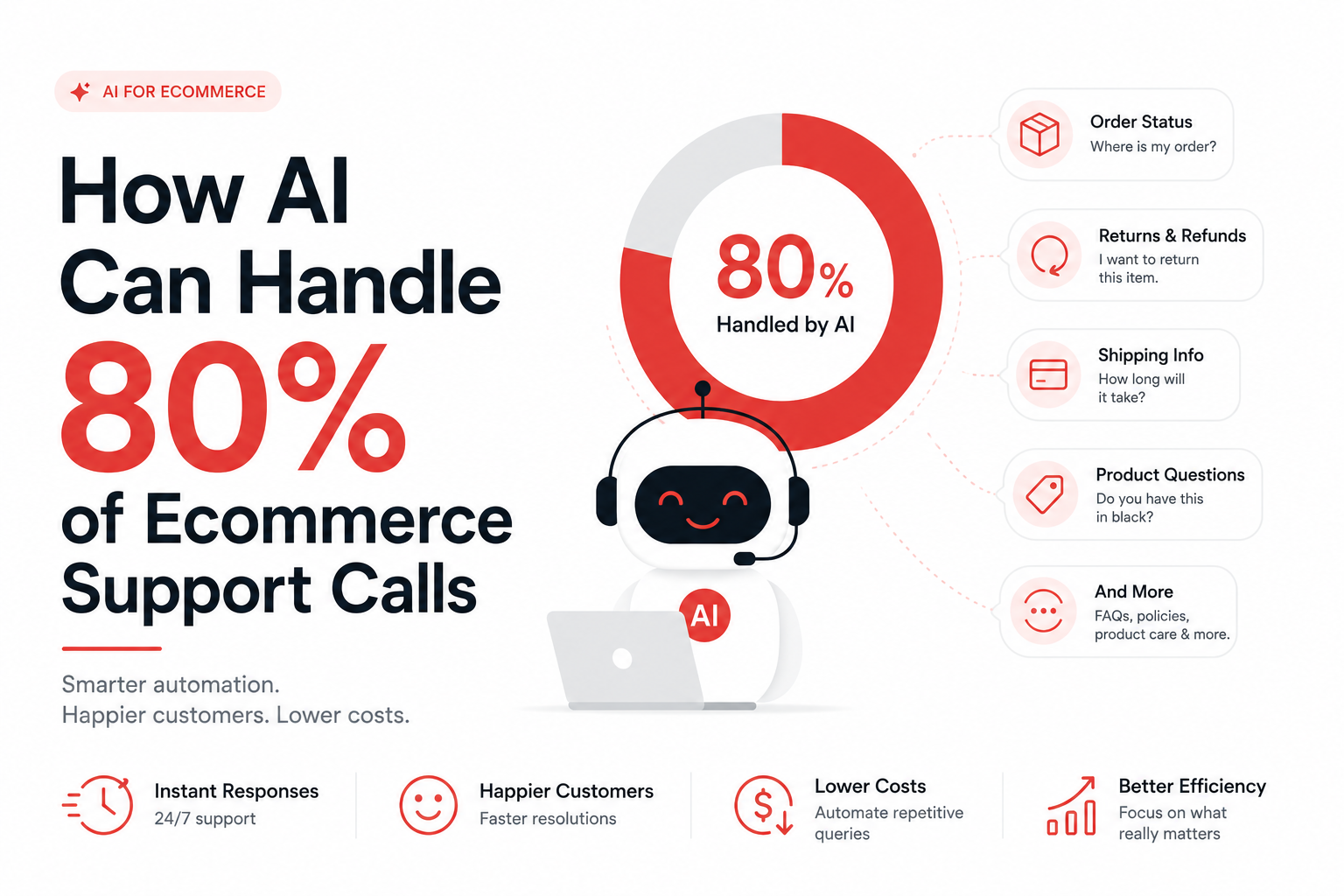
With the right workflows, AI can potentially handle a large percentage of routine ecommerce support calls—sometimes approaching 80%—while human agents focus on complex situations that require judgment, empathy, or exceptions.
Here's how it works.
Why Ecommerce Support Calls Are So Repetitive
Customer support feels different from customer to customer.
But from an operational perspective, many conversations follow the same patterns.
A customer wants to:
- Find an order
- Check delivery status
- Change an address
- Cancel an order
- Ask about a product
- Check inventory
- Start a return
- Request a refund
- Ask about shipping
- Place another order
The questions may be different, but the underlying workflows are often predictable.
That's exactly where AI can be useful.
Instead of training a human agent to perform the same workflow hundreds of times, businesses can teach an AI system how to handle that workflow automatically.
What Does "80% of Support Calls" Actually Mean?
The 80% figure shouldn't be treated as a universal rule.
Every ecommerce business has a different customer base, product catalog, policies, and support volume.
For one store, AI might be able to handle 50% of calls.
For another, it might handle significantly more.
The important distinction is between routine requests and complex requests.
Routine requests are structured and repeatable.
Complex requests require judgment.
AI is particularly effective at the first category.
1. Order Tracking and WISMO
One of the most common ecommerce support requests is:
WISMO — "Where Is My Order?"
A customer calls because they want to know where their package is.
A human agent typically needs to:
- Identify the customer
- Find the order
- Check the fulfillment status
- Open tracking information
- Explain the status
An AI employee connected to the store can perform these steps automatically.
The customer gets an answer immediately without waiting for an agent.
2. Shipping Address Changes
Customers frequently realize after placing an order that they entered the wrong address.
Instead of requiring a support agent to manually locate the order and update the information, an AI system can verify the customer, locate the order, and update the shipping address when the store's policies and fulfillment status allow it.
This turns a multi-step support workflow into a short conversation.
3. Order Cancellations
Another common request is:
"I want to cancel my order."
If the order is still eligible for cancellation, AI can verify the order, check its status, and process the cancellation according to the store's rules.
If the order has already shipped or requires an exception, the AI can escalate the conversation to a human.
4. Product and Inventory Questions
Customers often call before purchasing:
"Do you have this in a large?"
"Is the black version available?"
"When will this product be back in stock?"
Instead of sending customers to a website or making them wait for an agent, AI can check available product information and provide an answer immediately.
For ecommerce brands, this can also turn support conversations into sales opportunities.
5. Placing Orders Over the Phone
AI doesn't have to stop at answering questions.
A customer might call and say:
"I'd like to order the black hoodie in large."
An AI employee can guide the customer through the purchase process and, where supported by the store's workflow, place the order directly.
This changes the role of phone support.
Instead of being purely a cost center, customer calls can also become a sales channel.
6. Returns, Refunds and Damaged Products
Not every return or refund should be handled automatically.
But many stores have clearly defined policies.
AI can collect the relevant information, check the order, determine whether the request fits the store's policy, and initiate the appropriate workflow.
For unusual cases, the conversation can be escalated to a human.
This is important.
Good AI automation isn't about pretending it can solve everything.
It's about knowing which problems it should solve—and which ones it shouldn't.
7. Human Escalation Is Part of the System
This is one of the most important parts of an AI support system.
Imagine a customer says:
"My package says delivered, but I never received it—and I've already contacted support twice."
That's no longer a simple FAQ.
It may require investigation, judgment, or compensation.
Instead of forcing AI to handle the conversation, the system can transfer the customer to a human agent.
The ideal workflow looks like this:
AI handles the routine work → identifies exceptions → transfers to a human → provides the conversation context.
The customer shouldn't have to repeat everything they've already explained.
Human Agent vs AI Employee
The goal isn't to make humans disappear.
It's to make human support teams more productive.
| Support Task | Human Agent | AI Employee |
|---|---|---|
| Order tracking | Manual lookup | Automated |
| Shipping address change | Manual workflow | Automated when eligible |
| Order cancellation | Manual workflow | Automated when eligible |
| Product availability | Manual lookup | Instant lookup |
| Common FAQs | Repetitive | Automated |
| Support ticket creation | Manual | Automated |
| Simple order requests | Agent handles | AI can handle |
| Complex complaints | Human | Escalates to human |
| Exceptions & judgment | Human | Escalates to human |
| Availability | Usually scheduled | 24/7 |
The best setup isn't AI vs humans.
It's AI + humans.
How AI Gets to 80%
AI doesn't magically handle 80% of support calls.
You get there by systematically automating the highest-volume workflows.
Start by analyzing your support calls.
For example:
| Call Type | Monthly Calls | Automation Potential |
|---|---|---|
| Order tracking | 2,000 | High |
| Address changes | 500 | High |
| Order cancellations | 400 | High |
| Product questions | 350 | High |
| Returns | 300 | Medium |
| Complex complaints | 150 | Low |
If most of your support volume comes from predictable requests, automating those workflows can dramatically reduce the workload reaching human agents.
The exact percentage will vary by business.
But the principle remains the same:
Automate the highest-volume, lowest-complexity conversations first.
What Happens to the Support Team?
This is where AI support becomes interesting.
Instead of having agents spend their day answering:
"Where's my order?"
They can focus on:
- Angry customers
- Complex returns
- Fraud cases
- Special requests
- VIP customers
- Product issues
- Retention opportunities
The human team's role becomes more valuable.
They're no longer spending most of their time doing repetitive information retrieval.
How THAT WAS AI Handles Ecommerce Support Calls
THAT WAS AI is an AI employee built specifically for Shopify stores.
It can handle customer conversations over the phone and take actions inside Shopify rather than simply answering questions.
For example, it can:
- Track orders
- Change shipping addresses
- Cancel orders
- Check inventory
- Place orders over the phone
- Create support tickets
- Escalate complex conversations to human agents
The AI is designed to work alongside human support teams.
When it can confidently complete a routine request, it handles it.
When a conversation requires human judgment, it can hand it over.
That means Shopify brands can automate repetitive phone support without removing humans from the customer experience.
How to Start Automating Your Ecommerce Support
You don't need to automate everything on day one.
Start with your most common calls.
Step 1: Analyze your support volume
Find the top 5 reasons customers contact you.
Step 2: Identify repetitive workflows
Look for tasks that follow predictable steps.
Step 3: Automate the highest-volume workflows
Start with order tracking, address changes, cancellations, and product questions.
Step 4: Build clear escalation rules
Define exactly when AI should transfer a customer to a human.
Step 5: Measure the results
Track:
- Percentage of calls resolved by AI
- Human escalation rate
- Average handling time
- Customer satisfaction
- Cost per conversation
- Repeat contacts
Then keep improving.
Final Thoughts
The future of ecommerce customer support isn't necessarily humans vs AI.
It's humans doing the work that actually requires humans—and AI handling the repetitive conversations around them.
For stores with a large volume of routine support calls, AI can potentially automate a significant percentage of customer interactions.
The businesses that benefit most won't be the ones that blindly automate everything.
They'll be the ones that understand their support data, automate the right workflows, and build a seamless path to a human when customers need one.
Want to See an AI Employee Handle Your Shopify Calls?
THAT WAS AI lets Shopify stores automate customer phone support while keeping human agents in the loop.
Your AI employee can answer calls, look up orders, update eligible orders, check inventory, create support tickets, place orders, and transfer complex conversations to your team.
Want to see what it can do for your store?
Try THAT WAS AI or book a demo and experience the AI employee yourself.